Your CSMs show up every morning. By midday, they are buried in escalations, reactive requests, customer emails, internal asks, and whatever else blows up.
They are not driving change. They are just surviving it.
If that is your CS team, or the one you inherited, you are not alone. In B2B SaaS, growth often outruns processes. The “just solve it” mindset seems heroic until your people are exhausted, retention wobbles, and expansion plans never get built.
You need a CS culture that drives sustainable growth and prevents burnout. Here is how you build it.
1. Diagnose the Problem
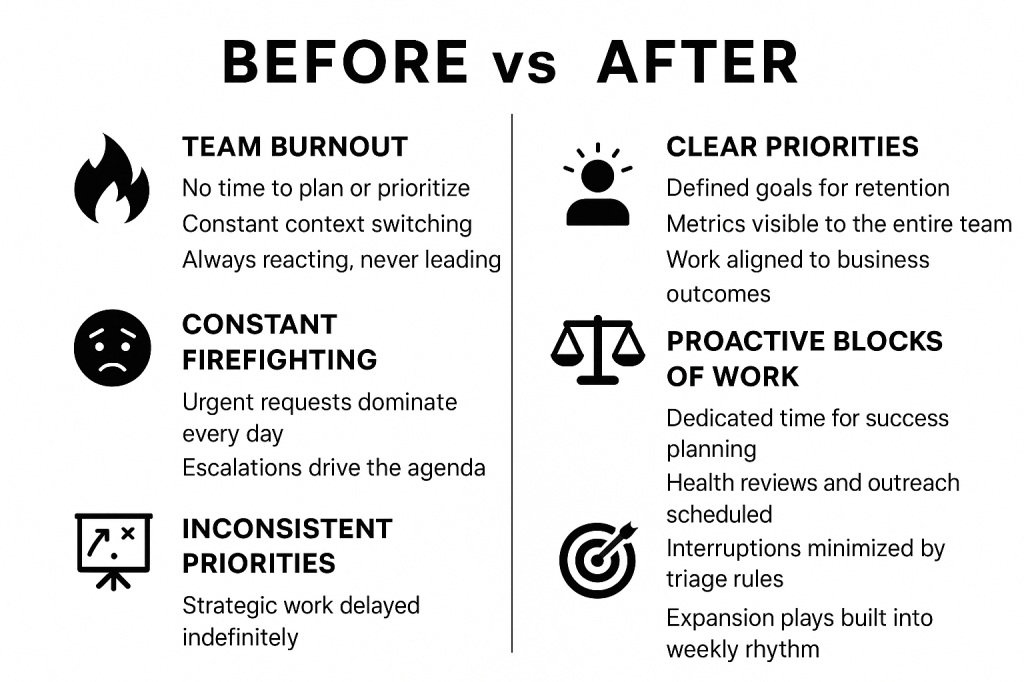
Firefighting shows up the same way in every CS org:
- Everything is urgent because there is no triage or prioritization.
- Strategic work never happens because there is no time for it.
- CSMs cannot say no and have no clear boundaries.
- Morale drops because there is no sense of progress.
- Growth stalls because reactive work does not scale.
The first step is admitting this is the system you have, even if you did not create it.
2. Anchor to a Definition of Success
Your team needs clarity on what “good CS” looks like. For most SaaS companies that means:
- Preventing churn, not just closing renewals
- Driving adoption so customers get value from the product
- Expanding usage when value is proven
- Building customer advocacy over time
When everyone knows the goal, it is easier to choose what matters most each day.
3. Build Guardrails Around the Chaos
Firefighting will always exist. It should not dominate the calendar.
Segment your customers so Strategic accounts get high-touch planning while mid-market and long-tail accounts get scalable programs or automation.
Create proactive work blocks each week where CSMs focus on health scores, renewal planning, and adoption outreach without interruption.
Set up triage rules so only real escalations jump the line. Everything else gets routed appropriately.
Use automated alerts from your CS platform so churn signals show up before the customer calls angry.
Finally, set clear role boundaries between CS, Support, and Sales so your team does not absorb every task that floats by.
4. Change the Culture
Culture shifts when leadership changes what it rewards.
- Highlight proactive wins in team meetings
- Share success stories about catching risks early or building adoption campaigns
- Train your team on prioritization and time blocking, not just product features
- Make it safe to raise broken processes instead of suffering through them
Stop rewarding the heroics of firefighting and start rewarding the systems that prevent fires.
5. Launch, Learn, and Scale
Do not overhaul everything at once.
Start with one segment or one team. Test proactive blocks, escalation rules, and alerts. Gather feedback. Iterate quickly.
Track metrics like proactive time, churn risk signals, expansions, and CSM satisfaction. Share them openly so the team sees progress.
Then scale what works across the organization.
6. The Goal: From Firefighters to Architects of Value
A CS team that plans its work instead of surviving its inbox delivers more growth, less churn, and better customer experiences.
It also keeps the people who make that growth possible (your CSMs) motivated and engaged.
Because when you build a CS culture that balances growth with sustainability, you do not just retain customers. You retain talent.
 Robert Statsky