For years I’ve been asked: “What kind of companies do you work best in?”
And the answer has always been incredibly consistent:
I do my best work scaling Customer Success in B2B SaaS companies between $20–50 million in Annual Recurring Revenue.
It’s a very specific range, but it’s specific for a reason. Companies at this stage share a unique set of characteristics that align perfectly with my skill set, leadership style, and operational strengths.
Does that mean it has to be exact that revenue amount? No. I can still work at a company making $15MM in revenue or $62MM in ARR. But this range, makes the most sense for what I bring to the table at this point my career.
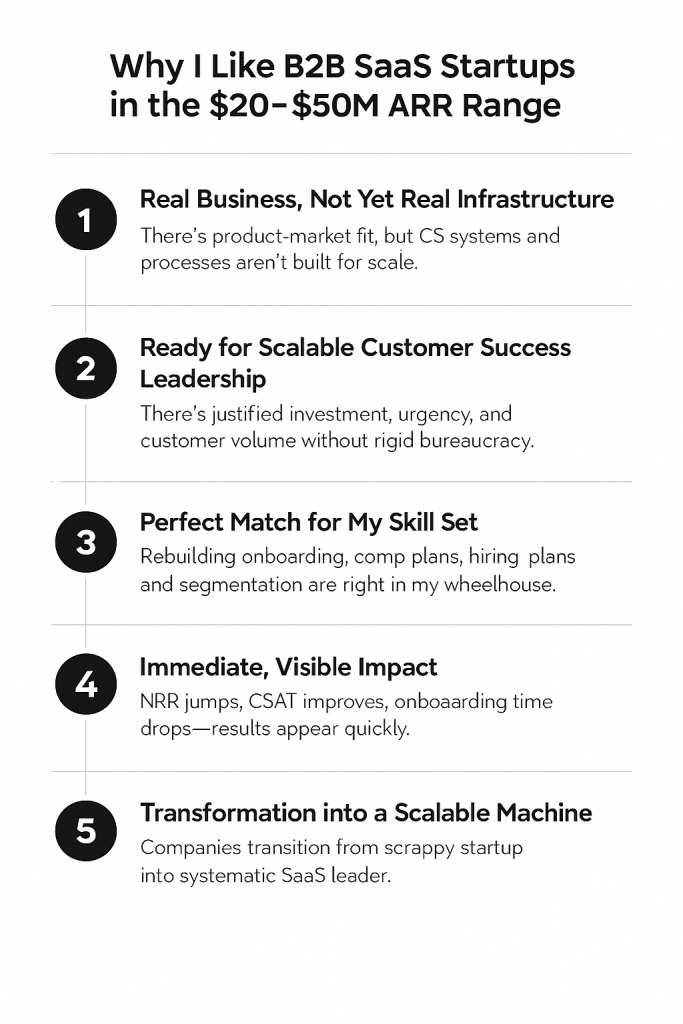
1. There Is a Real Business, But Not Yet Real Infrastructure
At ~$20MM ARR, most companies have:
- Solid product-market fit
- A functioning sales engine
- An early CS team (or something that resembles one)
- A growing customer base
- Clear demand from the market
They’re beyond the “Is this going to work?” phase.
But they’re not yet at the scale where systems, processes, and operational rigor are in place. This is where friction shows up:
- Onboarding can’t keep up
- CSMs are doing six different jobs
- Support is duct-taped together
- Renewals aren’t formally owned
- Segmentation is vague or nonexistent
- Customers feel the growing pains
This moment, where growth has arrived but infrastructure hasn’t, is exactly where I’m most effective.
2. The Company Is Ready for Scalable Customer Success Leadership
Before $20MM , you’re often still proving the model. After $50MM, you’re often managing layers of leaders and org-wide change management.
But between $20–$50MM, you get the perfect blend:
- Leadership wants real CS structure
- There’s enough ARR to justify investment
- There’s enough urgency to create change
- There’s enough customer volume to analyze patterns
- And still enough flexibility to build the CS engine “the right way”
This stage is where you move CS from “reactive customer management” to a revenue-driving operating function.
3. This Stage Requires the Exact Skills I’ve Spent 20 Years Building
This ARR range plays directly into my strengths:
- Rebuilding and modernizing onboarding
- Creating scalable implementation frameworks
- Designing engagement models
- Segmenting customers correctly
- Building hiring plans and headcount models
- Standing up renewals as a formal motion
- Building comp plans aligned with revenue
- Establishing CS + Product + Sales alignment
- Creating processes that survive rapid growth
- And doing it all fast, without breaking the business

When you scale Sales without scaling CS, the entire system collapses inward.
That collapse is preventable.
But only if you bring in someone who understands how to build for growth at the exact moment growth is accelerating. That’s been my specialty for two decades.
4. The Impact Is Tangible, Visible, and (Almost) Immediate
At this stage, you can see the direct impact of good CS leadership:
- NRR jumps
- CSAT improves
- Onboarding time decreases
- Renewal predictability increases
- Margin expands
- Support volume drops
- Product develops clearer signals from the field
and…
- The company stops feeling chaotic
Few things are more satisfying than seeing a previously strained CS function become a strategic advantage for the business.
5. The $20–50MM Range Is Where Companies Transform Into Scalable Machines
This is the phase where companies transition from:
Scrappy startup → Real SaaS company
Founder-led everything → Leadership-driven operations
Unpredictable revenue → Systematic, forecastable growth
Heroics → Scalable processes
It’s the moment where the company decides what it’s going to be in the next decade.
And it’s the moment where the right CS leadership makes the biggest difference.
Why This Range Fits Me Perfectly
Because this is where I can apply everything I’ve learned, every system I’ve built, and every hard lesson from scaling teams in North America, EMEA, and APAC.
It’s where the stakes are high, the opportunities are real, and the impact is massive.
And it’s where I help companies grow. Rather than collapse under their own momentum.
 Robert Statsky