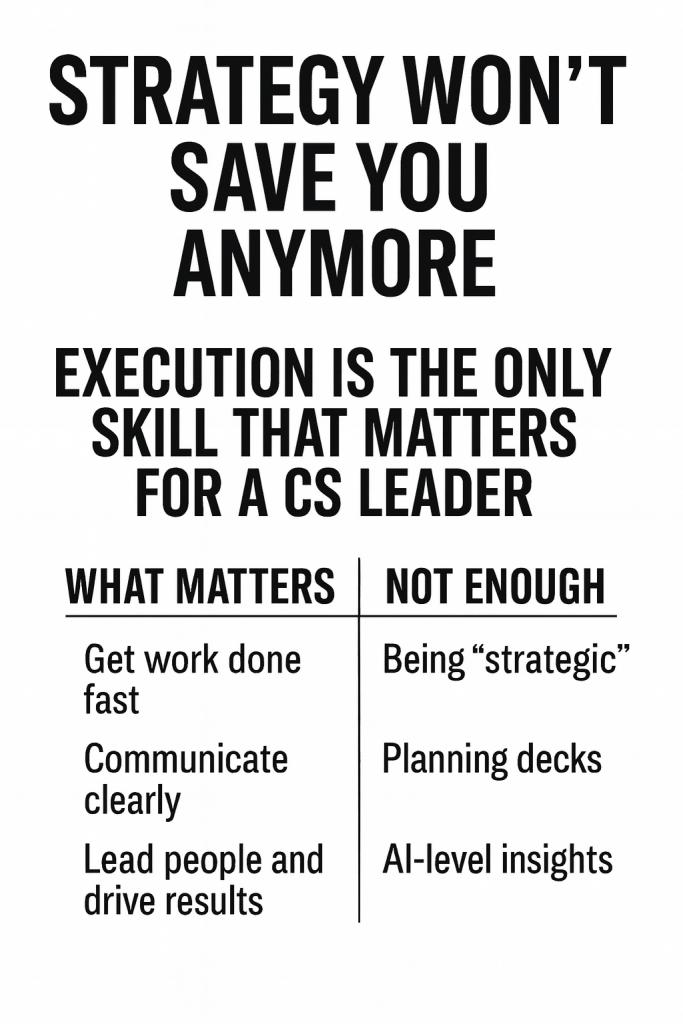
Execution Is the Only Competitive Advantage CS Leaders Have Left
For years, B2B SaaS companies hired Customer Success leaders because of their strategic thinking.
The frameworks.
The models.
The segmentation plans.
The onboarding architecture.
The health scoring.
The “strategic mindset.”
That era is gone.
You will no longer get hired simply because you’re strategic.
Especially not in Customer Success.
Strategy Has Been Fully Commoditized: Particularly in CS
A decade ago, building a CS strategy required deep subject matter expertise. It still matters, but it’s no longer the differentiator.
Today, a CS leader, or a founder, or a junior CSM, can generate:
- A complete customer journey map
- An onboarding playbook
- Role definitions for CSM/AM/Implementation
- A renewal and forecasting framework
- A Customer Health Score rubric
- An escalation process
- A Voice of Customer program
- A Customer Advisory Board plan
…all in seconds.
AI didn’t just democratize strategy. It made it indistinguishable. I even wrote about this a year ago. This was when the models were worse than they are now. Now they’re lightyears ahead of where they were a year ago. Chat GPT gets infinitely stronger each day. Each second really.
Which means companies no longer ask:
“Who has the best CS strategy?”
They ask:
“Who can actually implement anything in the real world?”
Execution Is Now the True Job of a Customer Success Leader
The modern CS leader is an operator first. Your value comes from your ability to:
- Drive cross-functional alignment
- Fix broken onboarding flows
- Set standards for customer communication
- Coach CSMs in real time
- Reduce time-to-value
- Improve product adoption
- Run escalations without panic
- Manage customers at the executive level
- Deliver accurate renewal forecasts
- Create predictable revenue outcomes
- Build processes that scale
- Move the organization forward when everything is on fire
These are not strategic tasks. These are executional tasks, and they are now the core of CS leadership.
Why Strategy Alone Doesn’t Matter in CS Anymore

Because the strategy isn’t what saves the renewal. Execution does.
The strategy doesn’t get the onboarding timeline back on track. Execution does.
The strategy doesn’t repair a damaged relationship with a CFO before renewal. Execution does.
The strategy doesn’t drive adoption of the new feature set. Execution does.
You can be brilliant strategically and still fail if you:
- Can’t communicate well
- Can’t drive urgency
- Can’t hold your team accountable
- Can’t collaborate with Sales and Product
- Can’t influence executives
- Can’t simplify complex problems
- Can’t operationalize anything
- Can’t lead under pressure
- Can’t make decisions without all the information
In CS, your leadership and operating discipline matter more than your IQ.
The Lie Many CS Leaders Still Believe
There’s still this idea floating around that strategy is the “higher order” skill the cerebral work reserved for those above the day-to-day grind.
But CS doesn’t work that way.
You can’t lead CS from 30,000 feet. You need to be in the weeds enough to understand:
- Why adoption is stalling
- Why onboarding is delayed
- Why the Product feedback loop is broken
- Why CSMs aren’t forecasting accurately
- Why execs don’t trust your data
- Why renewals feel chaotic
- Why expansion isn’t consistent
Being strategic won’t solve any of these. Being able to execute will. Plus, if you don’t want to talk to customers ever, you really shouldn’t be in this line of work. That is a core of the job. You need to be involved, when it’s good, when it’s bad, when there is an escalation. Thats the trend, it’s not just about swooping in to save the day or shaking hands at the beginning of the relationship.
Execution Is the New Differentiator in CS Leadership
The CS leaders who will be hired in this new era, and the ones who will thrive, are the ones who can:

- Implement processes quickly
- Build trust with customers
- Drive cross-functional collaboration
- Run tight internal communication rhythms
- Deliver predictable NRR
- Standardize the customer experience
- Guide teams through ambiguity
- Make decisions with imperfect information
- Move faster than everyone else
I strongly believe this has always been the case. Being effective at executing strategy quickly, efficiently and with positive results has always been a differentiating factor. That said, I think we might have reached a point, and if not now now we will very soon, where this is all that will matter for many companies.
Now I do also believe there is no substitute for experience, and having the confidence that comes with that. But if strategy is not as important at least from the start, your success will solely be judged on your ability to get results. That is critical, and that is definitely different than where things were a few years ago, and what people were traditionally hired to do.
A founder told me once, he knew “nothing about CS.” He really meant it, and said it to me to build trust in me and my ability to do my job. I don’t think anyone would say that to someone ever again. If you don’t know anything about something you can have a strategy, based upon data built-out in seconds.
How you execute that is what will matter, because as good as AI is, it can’t do all the work for you, it can’t manage your employees or ensure your customers listen to you. At least not yet.
Being smart, and having a plan doesn’t mean that it will work.
This is the skill set companies now screen for.
Because strategy is cheap.
Execution is rare.
The Winning CS Leader Going Forward
If you want to be hired, or stay relevant, as a CS leader in B2B SaaS, you need to be:
- A communicator
- A leader
- A coach
- An operator
- A problem‐solver
- A friction‐remover
- A builder
- A mobilizer
- A translator between teams
- Someone who gets things done faster and more effectively than everyone else
Not just a strategist. Not just someone with frameworks.
Execution is now the job.
And the CS leaders who understand this, who embrace the messy operational reality of B2B SaaS, are the ones who will stand out, get hired, and drive real revenue outcomes.
 Robert Statsky