Navigating internal politics, executive expectations, and roadmaps that survive scrutiny
At a software company, you don’t just manage deliverables. You manage perception, politics, and power. The biggest risks to your success rarely live in the code or the customer they live inside your company’s org chart.
Here’s how to approach it.
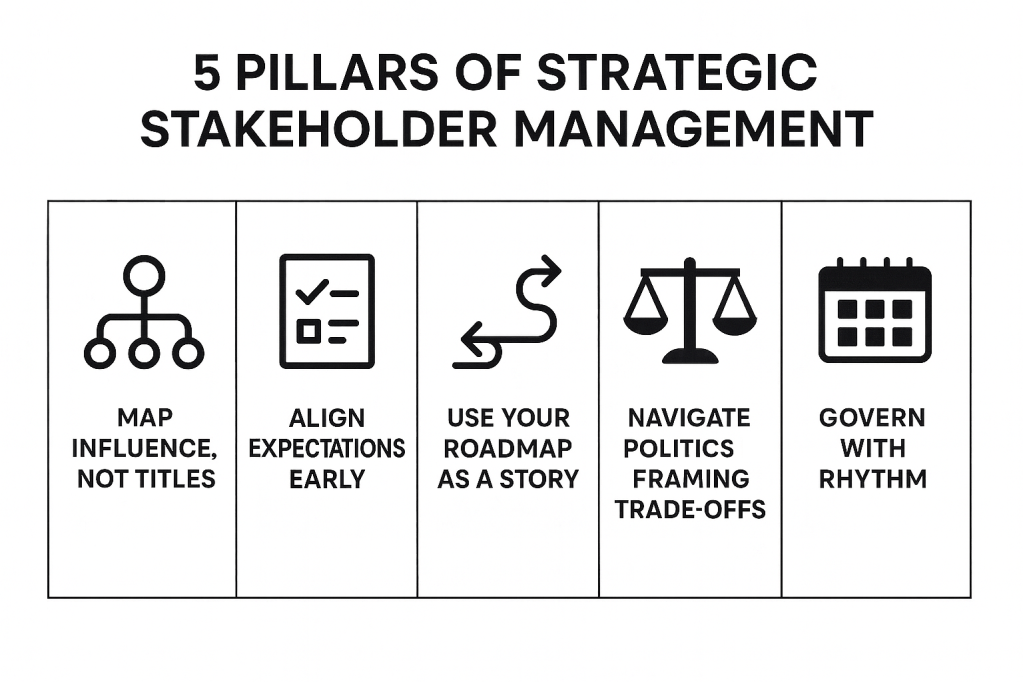
1. Map Influence, Not Titles
Many times at companies, formal structure doesn’t reflect real influence.
- Identify who controls budgets versus who shapes opinions.
- Track informal “power brokers” who drive adoption or resistance.
- Understand how each stakeholder measures success. Personal metrics often matter more than company metrics. While this is not ideal, it is just the way many companies operate.
Your influence map becomes your survival map.
Many startups will sell you on how they are different, and operate differently without bureaucracy. Then you join them and notice many of the things you’d notice at a larger organization, just on a smaller scale. It can be even more difficult if you have founders that are heavily involved in many aspects of the business. This is not always a guarantee, and it is different from company to company.
2. Align Expectations Early (and Reconfirm Often)
Executives rarely disagree on the what, they disagree on the when and how.
- Calibrate expectations up front: scope, success metrics, and trade-offs.
- Confirm those expectations in writing. Then revisit every 30–60 days.
- When alignment drifts, reset before velocity becomes waste.
3. Turn your Roadmap into a Story
A roadmap isn’t a schedule, it’s a communication instrument.
- Create three versions: executive (vision), leadership (priorities), and tactical (execution).
- Use visuals to communicate trade-offs: risks, capacity, dependencies.
- Keep it living and transparent. Trust grows when people see how and why decisions evolve.
4. Navigate Politics Without Losing Credibility
Politics aren’t a bug, they’re part of the system. Learn to use them as signals.
- Frame trade-offs in business terms (“If we shift here, we delay revenue by X”).
- Avoid taking sides and instead, facilitate clarity between functions.
- Anticipate objections and have data ready before the meeting starts.
Credibility is the currency that buys you alignment.
5. Govern with Rhythm, Not Reaction
If you only meet when things go wrong, you’re already behind.
- Establish recurring meetings, monthly health checks, quarterly value reviews.
- Use structured templates (status, risk, decisions, actions).
- Keep communication multi-layered: exec summaries for leaders, detailed notes for operators.
Rhythm creates stability and stability creates trust. So make sure you set yourself up with a standard operating rhythm and remain consistent with it. That will show everyone you know what you’re doing and that you’re dependable.
I cannot guarantee this will work in every organization. You might still run into issues, but you can at least know you are doing your part to be organized and efficient. The fault and or failure will not be with your leadership ability.
 Robert Statsky