So you’re a Director or first time VP and you need to start managing managers.
Hopefully you’ve been in leadership long enough to realize that getting other people to do something, and getting them to do it well is way harder than just managing your own time and completing tasks from another person’s direction.
I always say you know when someone is ready for leadership when they realize that being a leader is harder than managing yourself. Taking that level of responsibility is noble and the greatest thing you can do because it shows you care about the outcomes of others, and should be willing to put the success of others ahead of yourself.
So now that you have some managers under you, what do you do? Skip-levels? Get an assistant? Get paid more and put in less time? How do you structure your day? Where do you focus your time?
Time.
It always comes back to time.
It’s the one thing we all need that we’ll never have enough of. How are you managing your time each minute of every day? Where do you put your focus and how do you improve those working for you so you can have as many people be successful as possible?
There has been an extensive amount of literature written about management, leadership, managing teams, inspiration etc. I don’t need to quote all of those, but I will say is that it’s not about you anymore at all.
How can you get the most out of your team and get them to be the best managers/leaders ever?
Ask yourself:
- What needs to improve?
- How can I help?
- What do they want?
- Do these people want to be managers or do they just want more money?
- What is it they enjoy doing?
- What are their goals?
Then you need to be relentless in your ability to get them to a better spot. You don’t need to just order people around. You need to inspire them and get them to want to be better. They must feel they can trust you and get better by working with you. Ensure they are autonomous and are getting better on each interaction.
It is not easy, and it never ends, and it takes time to get good, but you need to be able to have the tough conversations and get the team to where they need to be.
Identify how they are organizing their time. Ask yourself where they are getting caught up, and what efficiencies you can drum up.
Find out where they are struggling and what tasks they don’t like. Train them on those, get them to a better place so they can isolate what they are doing. Understand those motivations and then use those to train them.
Learn to appreciate the process and make sure there is trust. Try to build that trust over time.
Per ChatGPT here is a more structured approach for those just starting out in a VP or Sr. Director type role.
Managing managers requires you to shift from a “player-coach” mindset to an organizational builder and strategic enabler. You’re no longer managing individual CSM outcomes directly—you’re managing how your managers manage and ensuring alignment with the company’s growth objectives.
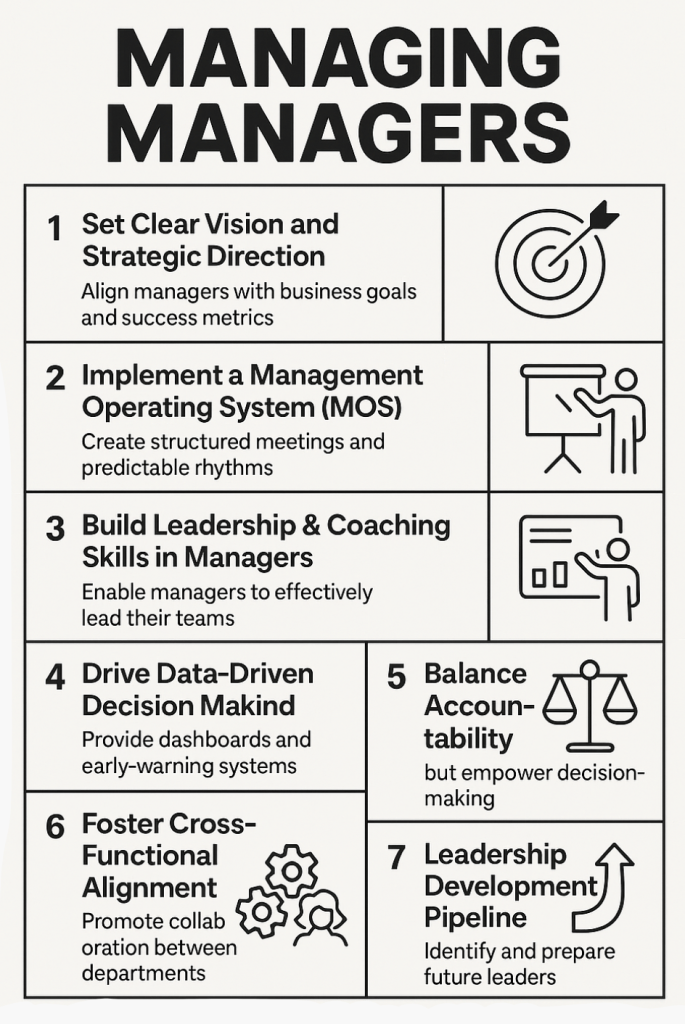
Here’s a structured approach:
1. Set Clear Vision and Strategic Direction
- Company CS Strategy Alignment: Start with a clear understanding of business goals (retention, expansion, NRR, customer advocacy). Your job is to cascade this strategy into actionable objectives for each manager.
- Defined Success Metrics: Move beyond anecdotal success—ensure every manager knows the KPIs that matter:
- Gross & Net Revenue Retention (GRR, NRR)
- Expansion pipeline contribution
- Customer Health Index improvements
- NPS/CSAT targets
Example:
“Our north star this quarter: NRR ≥ 120%. Directors, break this into team-level adoption, expansion, and renewal KPIs.”
2. Implement a Management Operating System (MOS)
Create a structured cadence so managers are aligned and supported:
- Weekly Director/Manager 1:1s: Focus on coaching, removing roadblocks, reviewing metrics, and leadership development—not just status updates.
- Monthly CS Leadership Meeting: Strategic reviews, cross-functional collaboration with Product/Sales, major risks, and customer advocacy wins.
- Quarterly Planning: Align on headcount, capacity planning, process improvements, and tech investments.
This avoids micromanagement and creates a predictable rhythm for leadership accountability.
3. Build Leadership & Coaching Skills in Managers
Your managers are multipliers. They must be great coaches for their teams:
- Manager Playbooks: Provide frameworks for QBR prep, renewal risk reviews, onboarding journeys, and customer escalations.
- CSM Enablement: Train managers to run pipeline reviews, forecast expansions, and coach CSMs on value-based selling.
- Leadership Workshops: Topics like “Leading Through Change,” “Difficult Conversations,” and “Strategic Customer Planning.”
Goal: Managers become decision-makers, not just information pass-through points.
4. Drive Data-Driven Decision Making
- Dashboards for Managers: Each manager should own a dashboard showing team health, renewals, expansions, and adoption metrics.
- Early-Warning Systems: Standardize red/yellow/green health scores, renewal risk categories, and escalation SLAs.
- Quarterly Deep Dives: Use data to identify systemic issues (e.g., onboarding delays) vs. one-off problems.
This keeps conversations future-focused vs. reactive firefighting.
5. Balance Accountability and Autonomy
- Non-Negotiables: Clear processes for escalations, churn risk handling, and QBR cadence.
- Empower Decision-Making: Give managers latitude on how they coach their teams, handle day-to-day tasks, and structure internal meetings.
Your role: Set the “what” and “why.”
Managers: Own the “how.”
6. Foster Cross-Functional Alignment
- Ensure managers build strong ties with Product, Sales, and Marketing.
- Have managers run closed-loop feedback sessions with Product for roadmap prioritization.
- Partner with Sales on land-and-expand motions—this drives NRR growth.
7. Leadership Development Pipeline
Treat your manager layer as future VPs/Directors:
- Succession Planning: Identify high-potential managers for stretch assignments.
- Shadowing: Let managers attend exec calls, board QBRs, or key renewal negotiations to gain exposure.
This keeps them motivated and growing rather than plateauing.
 Robert Statsky