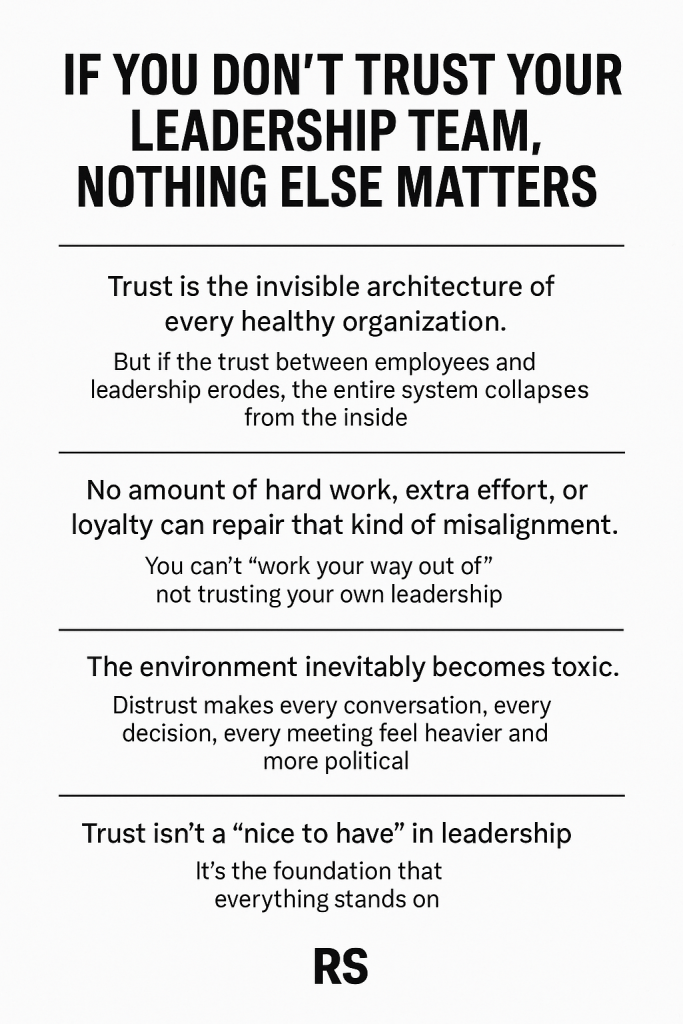
Trust is the invisible architecture of every healthy organization. You can have a brilliant product, talented people, and impressive funding, but if the trust between employees and leadership erodes, the entire system collapses from the inside.
I’m not the person who tells people to quit their jobs recklessly. Most of us don’t have that luxury, and honestly, most situations don’t require that level of urgency. But there is one situation where you should leave as soon as it’s reasonably possible:
When you can no longer trust your leadership team.
I’m not talking about normal frustration, organizational chaos, or the natural friction that happens in fast-moving companies. I’m talking about the deeper signal. The unmistakable feeling that leadership is no longer aligned with reality, operating transparently, or acting in a way that makes sense for customers, employees, or the business long-term.
When that trust breaks, everything else becomes impossible:
- You second-guess decisions instead of supporting them
- You hesitate to fully commit to the work
- You spend more time managing internal politics than customer outcomes
- You start protecting yourself rather than collaborating
- The work becomes heavier, even when nothing operationally has changed
And here’s the hard truth: No amount of hard work, extra effort, or loyalty can repair that kind of misalignment. You can’t “work your way out of” not trusting your own leadership.
In my own career, every role I’ve left shared one common denominator:
There was a moment, sometimes small, sometimes explosive, where I realized I didn’t trust the leadership direction anymore. Not necessarily because they were “bad people” or malicious (although sometimes they were), but because the alignment wasn’t there. The clarity wasn’t there. The honesty wasn’t there.
And once trust goes, the environment inevitably becomes toxic.Not because anyone intends it to, but because distrust makes every conversation, every decision, every meeting feel heavier and more political. The organization becomes exhausting.
You deserve to work in a place where you trust the people responsible for guiding the ship.
Where decisions make sense.
Where communication is clear.
Where vision feels real, not performative.
Trust isn’t a “nice to have” in leadership.
It’s the foundation that everything stands on.
And when the foundation cracks, staying will cost you far more than leaving ever will.
 Robert Statsky