This topic is personal for me because I’ve had to rebuild full-cycle Customer Success teams at almost every company I’ve joined.
Most CS organizations start the same way:
Support → evolves into → “CS” → evolves into → generalized fire-fighting 🧯🚒
When I’m hired as the first dedicated CS leader, I usually inherit a team doing everything: onboarding, support, renewals, expansion, technical troubleshooting, product feedback, QBRs. And while that works early on, it’s not scalable.
Here’s the exact framework I use to transition full-cycle CSMs into a structured, specialized, high-performing CS organization.
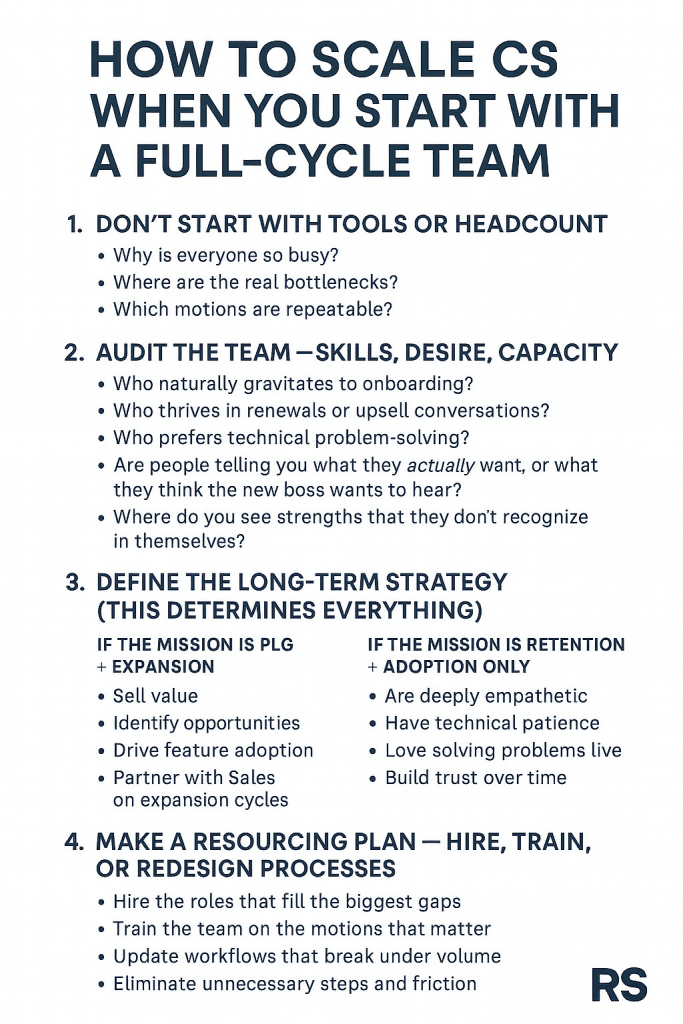
Step 1: Don’t Start With Tools or Headcount
Before you hire, pause and diagnose:
- Why is everyone so busy?
- Where are the real bottlenecks?
- Which motions are repeatable?
- Which responsibilities shouldn’t even exist anymore?
Scaling starts with clarity, not tools.
Step 2: Audit the Team: Skills, Desire, Capacity
This is the most overlooked part of the process.
Ask and observe:
- Who naturally gravitates to onboarding?
- Who thrives in renewals or upsell conversations?
- Who prefers technical problem-solving?
- Are people telling you what they actually want, or what they think the new boss wants to hear?
- Where do you see strengths that they don’t recognize in themselves?
True scale comes from getting the right people in the right roles as fast as possible.

Step 3: Define the Long-Term Strategy (This Determines Everything)
Specialization only makes sense when it aligns with the company’s direction.
If the mission is PLG + expansion:
You need CSMs who:
- Sell value
- Identify opportunities
- Drive feature adoption
- Partner with Sales on expansion cycles
If the mission is retention + adoption only:
You need CSMs who:
- Are deeply empathetic
- Have technical patience
- Love solving problems live with customers
- Build trust over time
Your org design must support the outcomes the company actually cares about. This is where most teams get stuck. What one person cares about (normally a founder) and what another person cares about (sometimes the outside CRO hire) are drastically different.
The competing incentives will very quickly destroy momentum and your operating rhythm. Sometimes your direct manager who is revenue focused will want the team to work on one thing while the founder or other leaders have other priorities.
You must nail this step, or everything else will be tainted.
Step 4: Build Your Specialization Blueprint
Here’s the typical scale path I implement:
1. Implementation / Onboarding
Remove onboarding from CSMs first: it’s the biggest drag on capacity. Put your technical people or problem solvers that are good with clients, responsive and organized in this role.
2. Support or Technical Success
Move troubleshooting and ticket volumes away from CSMs so they can focus on relationships.
3. Renewals / Account Management
This removes the quota-pressure confusion and gives renewals a clear owner. CSMs can 100% handle renewals at most SaaS businesses. If they can’t, its possible there are more complex negotiations or multiple products. But I’d say at 80-90% of the SaaS businesses I’ve seen, the vast majority of CSMs can handle this step with a little bit of training.
4. Strategic / Enterprise CSMs
Now your CSMs can focus on adoption, expansion strategy, and long-term value. Give the higher dollar value customers to these people.
5. Ops + Enablement
At scale, you need someone who owns systems, processes, data, and reporting. This sequence prevents chaos and builds clarity across the entire customer journey.
Step 5: Make a Resourcing Plan: Hire, Train, or Redesign Processes
Once you know where you’re going:
- Hire the roles that fill the biggest gaps
- Train the team on the motions that matter
- Update workflows that break under volume
- Eliminate unnecessary steps and friction
Align with Sales on growth projections - Fight for budget with data, not emotion
I’ve never worked at a company that was “happy to throw money at CS.” You need a plan, a model, and a business case.
Step 6: Roll Out the New Structure Transparently
Specialization feels threatening to a previously full-cycle team.
Handle with care:
- Explain why the change is happening
- Show how roles will evolve
- Provide clarity on growth paths
- Keep feedback loops open
- Celebrate early wins
- Encourage the team to build the process with you.
- Reinforce that this is about scale, not demotion
People adopt change when they understand it.
Scaling CS isn’t about fancy org charts or trendy titles.
It’s about designing a system that removes noise, increases clarity, and helps every customer and every CSM succeed.
Put the right people in the right roles at the right time, and the entire company scales with you. Do this fast, support it with data and be decisive.
 Robert Statsky