The subscription economy has revolutionized B2B SaaS. As you’ll find throughout this site, from my CS leadership playbooks to anecdotes, the dynamic has shifted. When customers commit to a recurring payment, they’re not just buying access. They’re buying an ongoing relationship, a sustained business outcome, and a promise of value.

What differentiates the winners from the also-rans is how well the vendor and the CS organization manage the perception of value, not just delivery of features. Because perception drives renewal. If your customer doesn’t believe they’re getting more than they pay for, every renewal becomes a negotiation.
So how as a CS leader can you coach your team to embed value perception into their daily rhythm?
The Subscription Model Changed the Game
In a one-time purchase world you delivered, shipped, and succeeded (hopefully), and the customer owned the software. In the subscription world they’re asking themselves on EVERY INTERACTION: “Is this worth keeping?”
Software vendors switching to subscription models encounter customer resistance when prospects can’t clearly evaluate value before adoption. Another layer: the psychology behind subscription retention isn’t purely rational. Trust, fairness, ease of use, and the perception of ongoing benefit all play a role.
For Customer Success, that means the job isn’t over once the customer is onboarded and adopted. The job is to keep the customer convinced that value is real, measurable, and ongoing every time you speak with someone. It’s exhausting, but this is the model.
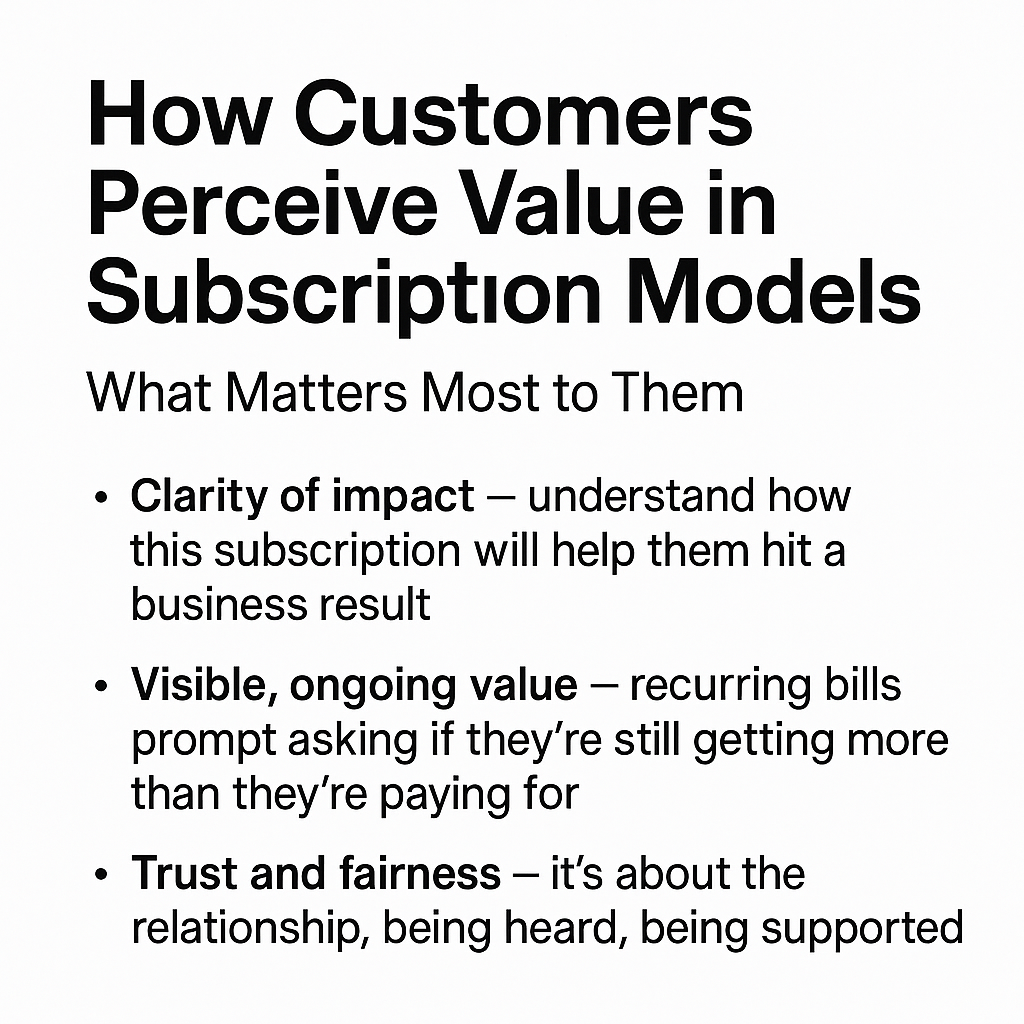
What Matters Most to Customers (and What Your CS Org Should Focus On)
1. Outcome and Business Impact
When customers buy a subscription, they are buying a business result, not just a product. As a CS leader, ask your team:
- What business goal drove this subscription decision?
- What metrics are we impacting and how are we showing that?
- At the next QBR, what proof point can we present to show value delivered?
The customer’s litmus test isn’t “Did I adopt it?” It’s “Did my business get better?”
2. Value vs. Cost Perception
It’s not enough for value to exist. The customer must perceive it. When customers feel they pay more than the value they receive, renewal risk rises.
Coaching questions for your team:
- How do we quantify value in the customer’s language?
- How do we surface and reinforce that value regularly?
- Are we segmenting customers by their value perception and tailoring outreach accordingly?
If a customer feels like they’re always paying but not always getting, renewal becomes transactional instead of relational. For lower price products that is fine, but for high ticket items. Good luck.
3. Trust, Experience, and Emotional Elements
Value perception isn’t purely logical. In subscription models the relationship is ongoing, so behavioral and emotional factors matter. Fair pricing, transparency, responsiveness, and being seen as a partner, not just a vendor, builds trust.
For your CS team:
- Encourage “value check-ins,” not just adoption reviews.
Coach CSMs to surface changes in customer context and adapt. - Build a culture of partnership where customers feel heard and prioritized.
4. Visibility of Ongoing and Future Value
In subscription models, stagnation is a killer. If nothing new happens, customers will eventually ask, “Why keep paying?”
Coaching tip:
- Don’t just report “we delivered X feature.” Instead, show “this helped you achieve Y business outcome, and here’s what’s next.”
- Create a “value roadmap” with the customer showing what will be unlocked in month 6, 12, and beyond.
- Remember: usage ≠ value. Use stories, data, and context.
Coaching Framework for CS Managers
- Value Discovery Session (Early in the Lifecycle)
- Map the customer’s strategic goals to your capabilities, success metrics, and timelines.
- Ensure CSMs can articulate value in business terms.
- Ask: “What does success look like for you this year? How will you measure it?”
- Quarterly Value Review
- Structure QBRs around value delivered versus value expected.
- Highlight progress, outcomes, and next steps.
- Avoid “we implemented X” without connecting it to “because that delivered Y impact.”
- Renewal Readiness Coaching
- Start 90–120 days before renewal. Ask: “What is the customer’s perception of value right now?”
- If it’s below 8/10, trigger a value reinforcement plan—business review, success audit, proof of outcomes.
- Expansion and Advocacy Pathway
- When customers strongly believe in value, they become advocates.
- Coach your team to identify “value believers” and activate them as references.
Why This Matters for CS Leadership
Building scalable CS operations means tracking KPIs like adoption, health scores, and retention. But that’s not enough. The next frontier is value perception, shifting your team from asking “Did they use it?” to “Do they believe it’s helping them win?”
That shift turns CS into a strategic growth engine. It positions your team inside the customer’s business narrative and creates measurable revenue impact.
Subscription models ask a continuous question: “Is this worth it?” If your CS organization only answers “yes” once, you’re at risk. The best teams answer “yes” every month, quarter, and year.
Help customers feel and believe the value, not just see it. Because when customers believe, they renew. And when they renew, they grow with you.
 Robert Statsky