When your primary contact at a customer transitions out, perhaps promoted, moved on, or leaves the company, it can feel like a moment of risk. That’s especially true in enterprise SaaS: you’ve built relationships, you’ve scoped roadmaps, you’ve aligned value journeys. Suddenly, a new face enters the canvas.
In my nearly two decades leading Customer Success in high-growth B2B SaaS, I’ve seen this scenario play out more times than I care to admit. And I’ve learned that handling this moment well can turn a potential disruption into a fresh opportunity.
Here’s how I recommend you approach it:
1. Pause to Understand the Change
The first instinct might be to jump right back into your regular cadence. Don’t do that.
- Recognize that the transition is a chance to learn. How long has this person been in the role? What’s their background? What internal pressures or priorities do they bring?
- Update your CRM (or whichever system you use) with the new stakeholder’s profile, their role, their objectives (even if you have to discover them), and how they map to your product use-cases.
- Revisit the “why” behind your collaboration: Is the use-case still the same? Has the customer’s context shifted (budget, organizational change, product scope, team structure)?
This contextual refresh ensures you don’t assume things are “business as usual”.
2. Bring Them Up to Speed Quickly and Clearly
Time is of the essence. A new stakeholder often has a steep ramp-up curve and limited patience.
- Prepare a concise “handoff briefing” for the new contact: what’s been achieved to date, what’s in flight, what challenges are visible, what wins are coming.
- Then schedule a meeting early, ideally within the first 30 days of their takeover. Use it to ask:
- “What are your top priorities for this product?”
- “How do you define success, 90 days out? 12 months out?”
- “How does your team like to work, communicate, and make decisions?”
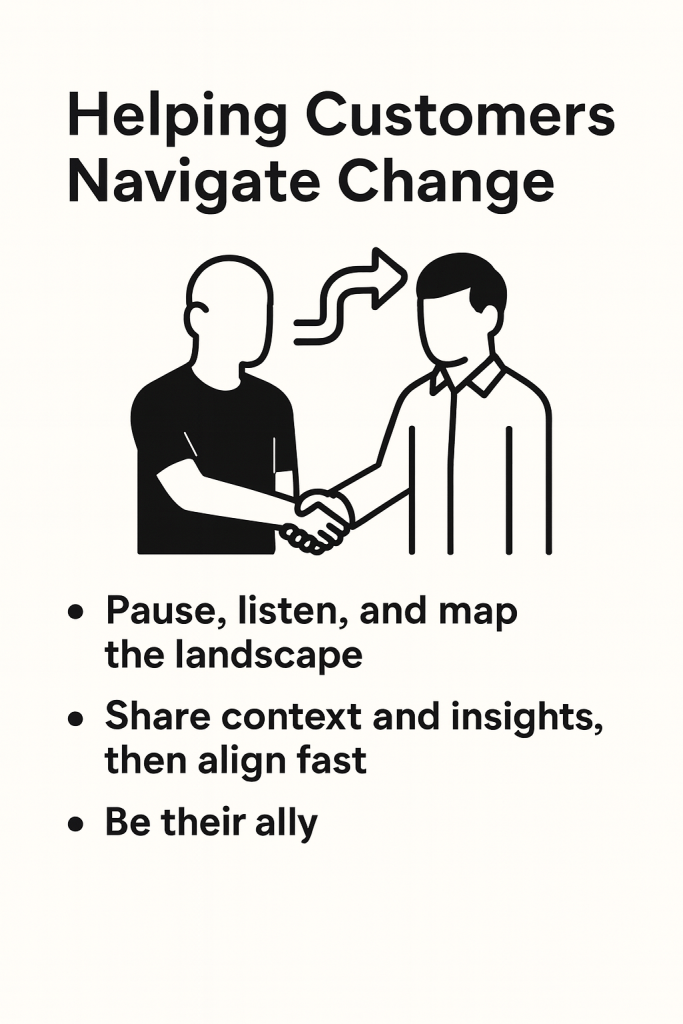
- Share your roadmap and ask for their input. This isn’t just “informing” them it’s aligning with them.
- By doing that, you shift from “legacy vendor” to “new stakeholder’s partner”.
3. Position Yourself as Their Ally
This is your chance to build a fresh relationship
- Frame your role explicitly as their advocate inside your organization.
- “How can I help you shine with your leadership? With your team? With your customers?”
- “How can I help you shine with your leadership? With your team? With your customers?”
- Offer to facilitate introductions (internally or externally), provide best-practice resources, or quick wins that align with their agenda.
- Set joint milestones.
- For example: “In the next 90 days, let’s focus on X metric and establish the foundation for Y use-case.” That ties you both to visible outcomes.
- For example: “In the next 90 days, let’s focus on X metric and establish the foundation for Y use-case.” That ties you both to visible outcomes.
- Communicate regularly, but intentionally. Set a cadence (bi-weekly or monthly) and stick to it. Provide value in every touchpoint (insights, data, user stories) so you become more than a checkbox on their vendor list. Over time, you want this new stakeholder to think: “I’m glad I have this person on my side.”
4. Watch for New Use-Cases & Emerging Champions
A stakeholder change often signals more than a person swap. It can open doors.
- New stakeholders may bring fresh priorities: maybe a new business unit, new workflow, or new user segment.
- Treat the change as a reconnaissance moment. Ask: “Are other teams evaluating this? Are there latent opportunities we haven’t yet explored?”
- Leverage your existing success to expand. For example, if you had success with Team A under the old contact, invite the new contact to share that story and replicate it with Team B.
In other words: this is not just continuity—it’s evolution.
5. Document and Transfer Knowledge Diligently
Behind the scenes, make sure your internal playbooks are current:
- Update your customer fact sheet with the new contact’s details and role.
- Document any shift in priorities or governance.
- Alert your internal team (CSM, Solutions Engineer, Customer Marketing) so everyone is aligned and projecting a unified front.
A smooth internal transition prevents missteps that could undermine the external relationship.
Change is inevitable in enterprise accounts. People move, teams reorganize, and priorities shift. But this doesn’t have to trigger churn risk. In fact, with the right posture it can become a moment of renewal: reaffirming your value, deepening your trust, and potentially unlocking fresh growth.
When you treat the arrival of a new stakeholder not as an interruption but as an opportunity, you secure your position and maybe even strengthen it. If you’re leading Customer Success or account management in a stable B2B SaaS company (or building toward that kind of role), this is one of those “soft skills + process” moments that separates the good from the great.
 Robert Statsky