There’s a trend I keep seeing across LinkedIn, Medium, Reddit, and the broader Customer Success conversation.
Everyone wants to be strategic.
Everyone wants to manage enterprise customers.
And yet, very few people are actually doing enterprise-level Customer Success.
I don’t say that to be dismissive. I say it because I’ve watched this movie play out repeatedly across six different companies.
Here’s the core issue:
Enterprise Customer Success does not meaningfully exist in early-stage CS organizations.
Enterprise is in the eye of the beholder.
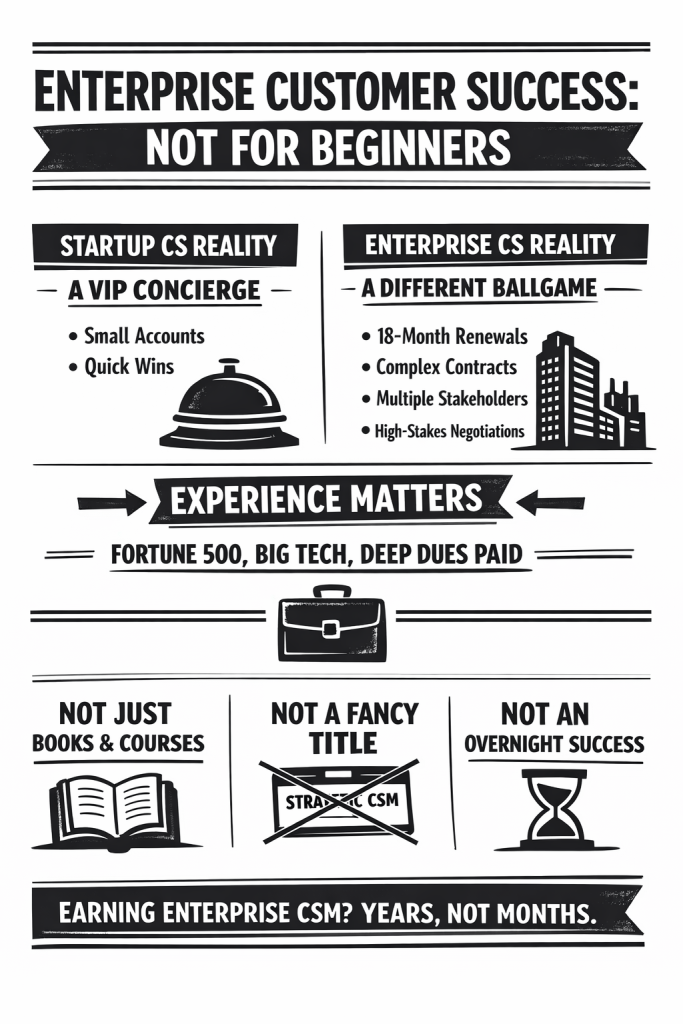
If your company has one small division of a Fortune 100 customer and assigns a CSM to it, that does not suddenly make the role “strategic.” In most cases, that CSM becomes a highly attentive concierge: managing emails, responding quickly, coordinating internally, escalating issues, and keeping the lights on.
That’s valuable work.
It’s often necessary work.
But it is not enterprise negotiation.
What Real Enterprise CS Actually Looks Like
True enterprise CS is a different discipline entirely.
It involves:
- Long-term, multi-year customer planning
- 6, 12, and even 18-month renewal and expansion cycles
- Multiple buying centers operating independently
- Executive sponsors who change roles mid-cycle
- Procurement, legal, security, and finance teams with veto power
- Negotiations where leverage, timing, and internal alignment matter as much as value
This is not something you “figure out” quickly.
That level of complexity takes years of exposure, not just skill.
Why Fortune 50 / 100 / 500 Experience Matters
Working inside a large public or Fortune-scale organization gives you things startups simply cannot:
- Repetition at scale
You see the same types of enterprise motions over and over: renewals, redlines, escalations, procurement resets, exec alignment failures. You’ll see this across dozens of accounts, not one. - Formal buying behavior
You learn how real enterprise organizations actually buy software, not how we wish they bought it. - Negotiation without heroics
Enterprise deals don’t close because someone “pushed harder.” They close because the process was managed correctly over time. - Political awareness
You learn how decisions are really made when five stakeholders say yes but one says no. - Risk containment, not just growth
In enterprise CS, survival is often the win. Avoiding churn is as strategic as expansion.
This exposure fundamentally rewires how you think about customers, leverage, and time.
A Moment of Honesty
I recently spoke with a VP of Customer Success who laid out exactly what he needed for his enterprise motion.
As he described it, I realized something important and said it out loud:
“That’s not me.”
And that wasn’t insecurity. It was honesty.
What he needed was someone who had spent significant time inside a Fortune 500 or public company. Someone who had lived inside massive account structures, survived large-scale renewals, and understood how enterprise buying actually works.
As much as I love startups, and I truly do, there is simply no way most early-stage CS ecosystems can prepare someone to negotiate contracts of that size and duration.
The Hard Truth About Experience
I’ve worked with hundreds of talented people over the years.
I don’t know a single person who was educated and developed exclusively through SMB/MM startups who suddenly emerged as an enterprise-grade CSM without exposure to large organizations.
That doesn’t mean startup CS isn’t valuable. It absolutely is.
There are transferable skills:
- Executive communication
- Value articulation
- Stakeholder management
- Risk identification
And yes, you can absolutely upskill through:
- Books
- Courses
- Mentorship
- Frameworks
I strongly encourage people to do all of that.
But there is no shortcut.
Enterprise CS Is a Different Animal
Managing true enterprise customers is slower.
More political.
More process-heavy.
More unforgiving.
And it requires reps, not theory.
After more than a decade and a half working with customers of all sizes, I feel confident operating across segments. But I’ve also learned to be honest about which environments produce which skills.
Enterprise Customer Success isn’t something you claim because it sounds impressive.
It’s something you earn through time, exposure, and some scars along the way.
Being clear about that distinction helps everyone, leaders, companies, and CSMs themselves, make better decisions about roles, hiring, and career paths.
 Robert Statsky