In SaaS and Customer Success, uncertainty is not the exception. It is the environment. Markets shift, customers change priorities, products pivot. Waiting for perfect information is a luxury most of us do not have.
The teams that win are not the ones that chase certainty, but the ones that can make clear decisions while the picture is still blurry.
Here is how I approach it:
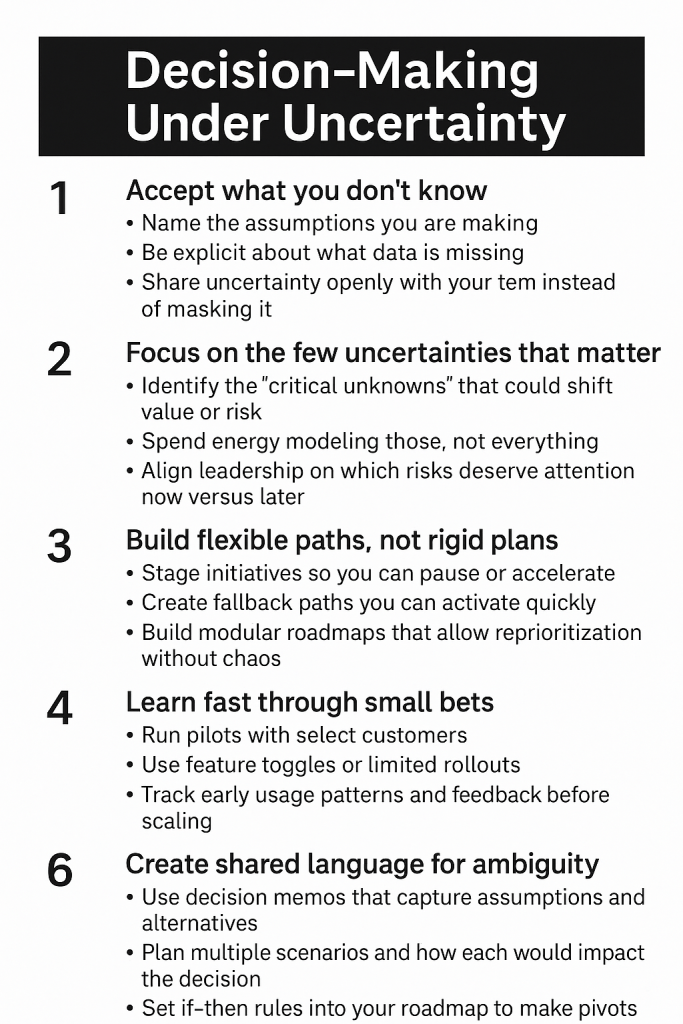
1. Accept what you don’t know
Every decision is a forecast. Even the safest move rests on assumptions that may turn out wrong. Acknowledging uncertainty helps prevent overconfidence and forces you to identify the real risks before acting.
- Name the assumptions you are making.
- Be explicit about what data is missing.
- Share uncertainty openly with your team instead of masking it.
2. Focus on the few uncertainties that matter
Not every unknown deserves attention. Ask: which assumptions, if wrong, would break the decision? Narrow your focus to the few factors that truly drive outcomes.
- Identify the “critical unknowns” that could shift value or risk.
- Spend energy modeling those, not everything.
- Align leadership on which risks deserve attention now versus later.
3. Build flexible paths, not rigid plans
Rigid strategies collapse when conditions change. Instead, design options that can work in multiple futures.
- Stage initiatives so you can pause or accelerate.
- Create fallback paths you can activate quickly.
- Build modular roadmaps that allow reprioritization without chaos.
4. Learn fast through small bets
Big commitments under uncertainty are dangerous. Start with small, contained experiments.
- Run pilots with select customers.
- Use feature toggles or limited rollouts.
- Track early usage patterns and feedback before scaling.
5. Judge process, not just outcomes
A good decision can still have a bad outcome. What matters is the thinking behind it.
- Review the quality of the decision-making process, not just results.
- Reward teams for testing assumptions, not for being “right.”
- Avoid punishing failures that came from well-reasoned bets.
6. Create shared language for ambiguity
Uncertainty paralyzes teams when they don’t know how to talk about it. Create frameworks that make ambiguity easier to handle.
- Use decision memos that capture assumptions and alternatives.
- Plan multiple scenarios and how each would impact the decision.
- Set if-then rules into your roadmap to make pivots easier.
7. Monitor early and adjust quickly
Once a decision is made, it is not locked forever. Set up systems to detect when a course change is needed.
- Define early warning metrics and leading indicators.
- Build in review checkpoints to validate direction.
- Move fast to reverse or refine when signals show the path is wrong.
Things to Remember
The goal is not to eliminate uncertainty. It is to navigate it. Leaders who admit what they don’t know, create flexibility, and act with discipline are the ones who guide their teams through turbulence.
In my experience leading CS teams, the ability to decide without full certainty has been the difference between growth and stall. The companies that build this muscle thrive even when the ground keeps shifting.
A manager of mine once said, “You can only operate off the information you have, even if you know it is not 100% accurate. Commit and have the best intentions, but be open to change.”
That really stuck with me. It was almost as if I was given permission to operate off data I knew might not be 100% correct, but the leader knew we had to move forward and waiting for things to be perfect would slow us down.
 Robert Statsky